What we've built.
Six kinds of work, all of them live: two online stores, a bookshop platform built from the data model up, a console for a data-centre estate, a Teams security dashboard, and the marketing we run every month. Plus two design concepts, for a hospital and a travel company, labelled as exactly that.
Built to be looked at, and to be fast.
A site is a physical object on somebody's desk and in somebody's hand, usually at the same time. We design for both at once — the same layout, the same content, laid out for the screen it actually landed on.
- Designed on the small screen first
- Real content, not lorem and a stock photo
- Tuned until it loads on a bad connection
- Yours to edit without ringing us
A mark that survives leaving the screen.
Most logos are drawn once, flat, and then break the first time somebody needs them embossed, engraved, or one colour on a dark shirt. We build the geometry so it holds up in all of it — which is easiest to show by lifting one off the page.
- Drawn as geometry, not traced from a sketch
- Works in one colour, and at 16 pixels
- A system with rules, not a single file
- Every asset generated from one source
The screens behind the business.
Dashboards, consoles and internal tools — the software a team actually runs on, where the job is making a lot of information legible rather than making a page pretty. Two of these are shipped and in daily use.
- Built around how the team already works
- The detail one click under the summary
- Fast with real data, not just demo data
- Yours — no per-seat licence at the end
A WordPress online store selling repairs, vapes and accessories.
Three very different product lines in one shop: search across the whole catalogue, customer accounts, a cart, and promotional codes the team run themselves — live at mkrepairz.com.
- Client
- MK Repairz
- Live at
- mkrepairz.com
- Service
- WordPress ecommerce
- Delivered
- 2026
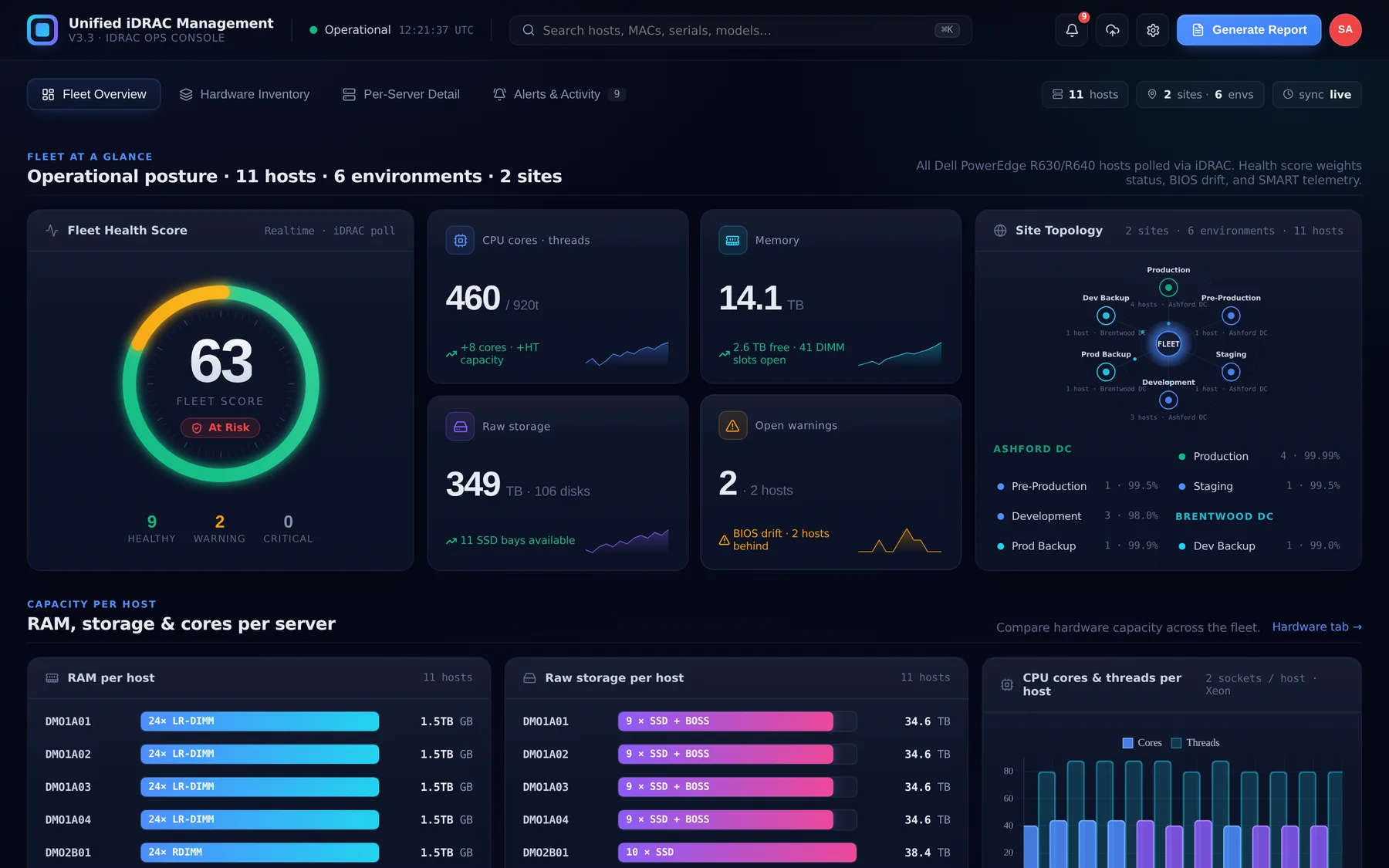
Unified iDRAC Management — every server in one console.
A single console for a whole Dell PowerEdge estate managed through iDRAC. Rather than opening one out-of-band interface per server, it consolidates every host into one view: fleet health, full hardware inventory down to the DIMM slot and drive bay, configuration drift, active faults, and reports you can hand to procurement or an auditor.
- Every iDRAC host in one console, across multiple sites and environments
- Fleet health scoring that weights status, firmware drift and drive telemetry
- Full hardware inventory: CPU, memory, disks, RAID, NICs, PSUs, fans, transceivers
- Faults, wear and BIOS drift surfaced automatically, ranked by severity
ZEVAR — a jewellery store designed around how jewellery is actually bought.
Most jewellery goes online through a template that treats a hand-set kundan piece like a phone case. We designed the opposite: a storefront where photography is the interface, browsing works by occasion as well as by piece, bridal sells as a matched set rather than four products, and the checkout is built around Cash on Delivery and WhatsApp — because that is how the market it was drawn for actually pays. Bilingual wordmark, in Latin and Urdu. Designed end to end, and live.
- Photography-led product pages — the piece is the interface, not a thumbnail
- Browsing by occasion as well as by piece — everyday, party, wedding
- Bridal merchandised as one matched set, opened by a WhatsApp styling call
- Materials stated plainly — plating, zircon, faux pearl, skin-friendly base
- Cash on Delivery and rupee pricing designed in, not bolted on
The design is a pattern rather than a one-off, so rebuilding it around another jewellery brand costs a fraction of designing one from scratch. The case study walks through all nine screens — fold, occasion browsing, catalogue, filters, the box, bridal and the phone layout — with the reason for each decision.
BookCart — new and used books in one basket.
A 5,475-title bookshop built on Next.js 15 with Payload CMS embedded in the same application — one deploy, one thing to secure, and a WordPress-like admin for the person merchandising it. It was built rather than bought because the catalogue does not fit a template: a used copy needs a condition grade, a new one needs neither, and both have to share a basket.
- 5,475 titles, faceted by condition, format, genre and reading age
- New and second-hand modelled as one catalogue, each described honestly
- Customer accounts, basket and checkout — verified in production
- SEO built in from the first commit: sitemap, JSON-LD, redirects, per-page meta
- Vercel + Neon Postgres + Cloudflare R2, deploying from main
Payments are the next piece of work — orders reach pending-payment and stop there, and the case study says so rather than implying a working till.
Teams Link Monitor — the links shared in Teams, checked and explained.
A security dashboard for Microsoft Teams. It reads the links shared in the chats and channels you authorise it to watch, checks each one against two independent threat-intelligence feeds, flags phishing language in the message text itself, and surfaces when the same malicious link is spreading across several people. It grew from a link scanner into a small SOC platform: case triage, audit logging, SIEM export and campaign detection — with three AI features that run on a local model, so message text is never sent to a cloud AI service. The links themselves are sent to VirusTotal and URLhaus for their reputation checks — that is how the checking works.
- Dual-engine URL reputation — VirusTotal and URLhaus, cross-checked against each other
- Campaign detection: the same bad link shared by several people surfaces as one incident
- Phishing-language detection on message text, so a message with no link at all still gets caught
- Case management — triage status, assignment and a running analyst-note log per URL
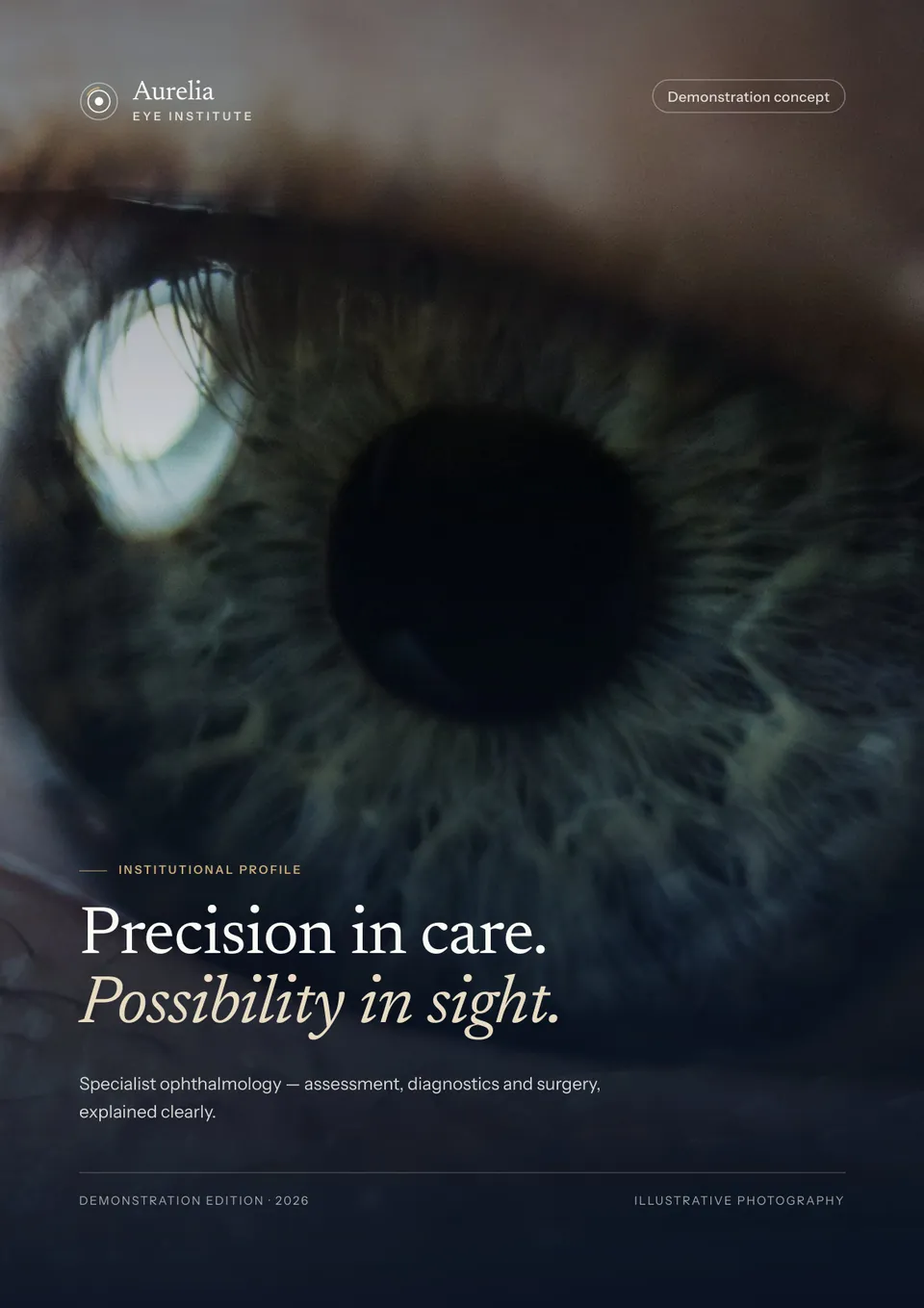
Aurelia Eye Institute — a hospital profile that claims nothing it cannot prove.
A design concept, not client work: a 16-page institutional profile for a specialist eye hospital, under a fictional name. Every service is explained in the patient's words, every medical sentence names its source, every photograph is labelled as illustrative, and no accreditation, outcome or credential is invented — the spaces for those are left for the hospital to fill with verified facts.
- Six sub-specialities, each with what an assessment involves
- Sourced to the National Eye Institute, the AAO and the FDA
- Urgent symptoms stated plainly, where a worried reader looks
- Stock photography labelled and credited, never passed off as real staff
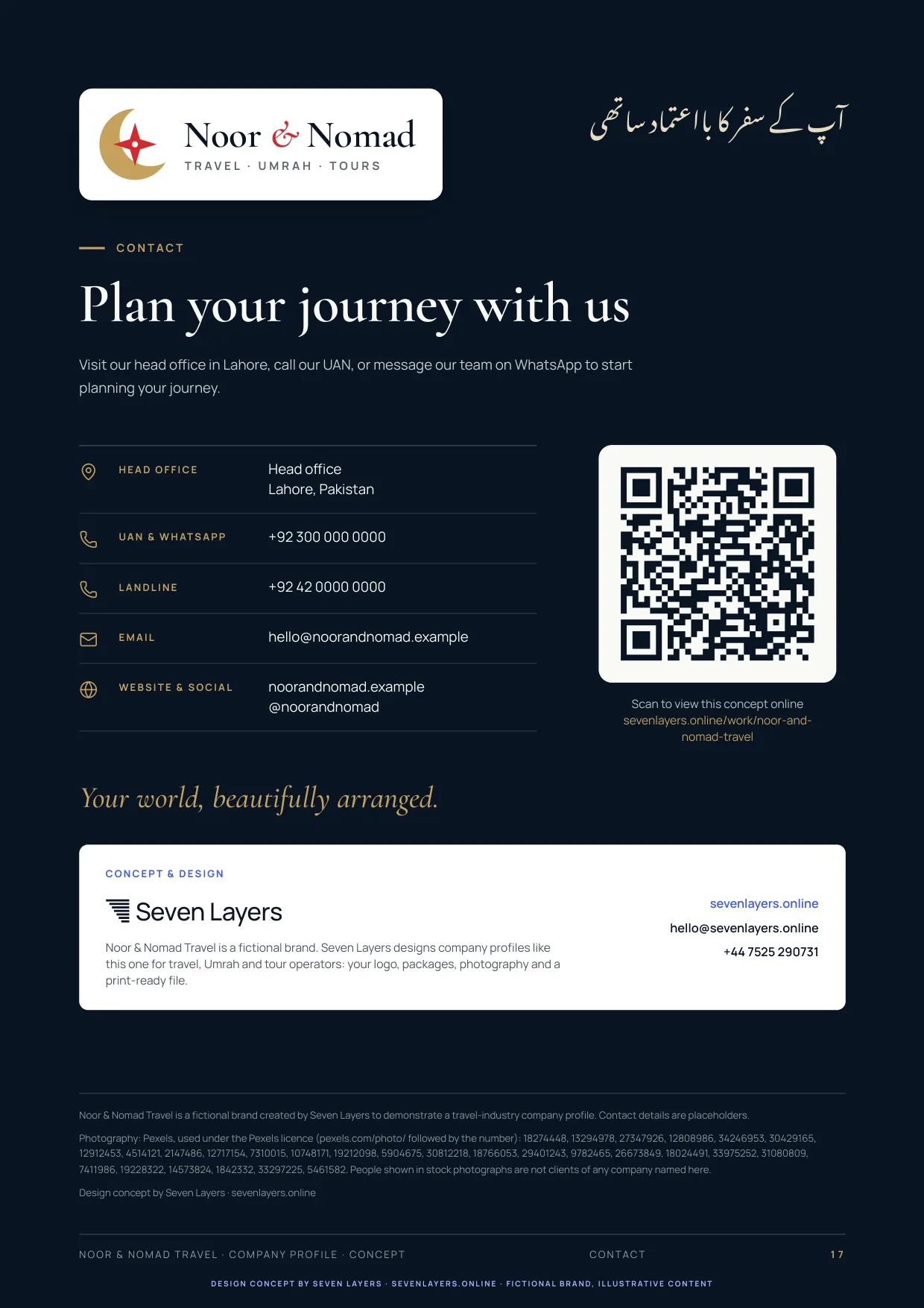
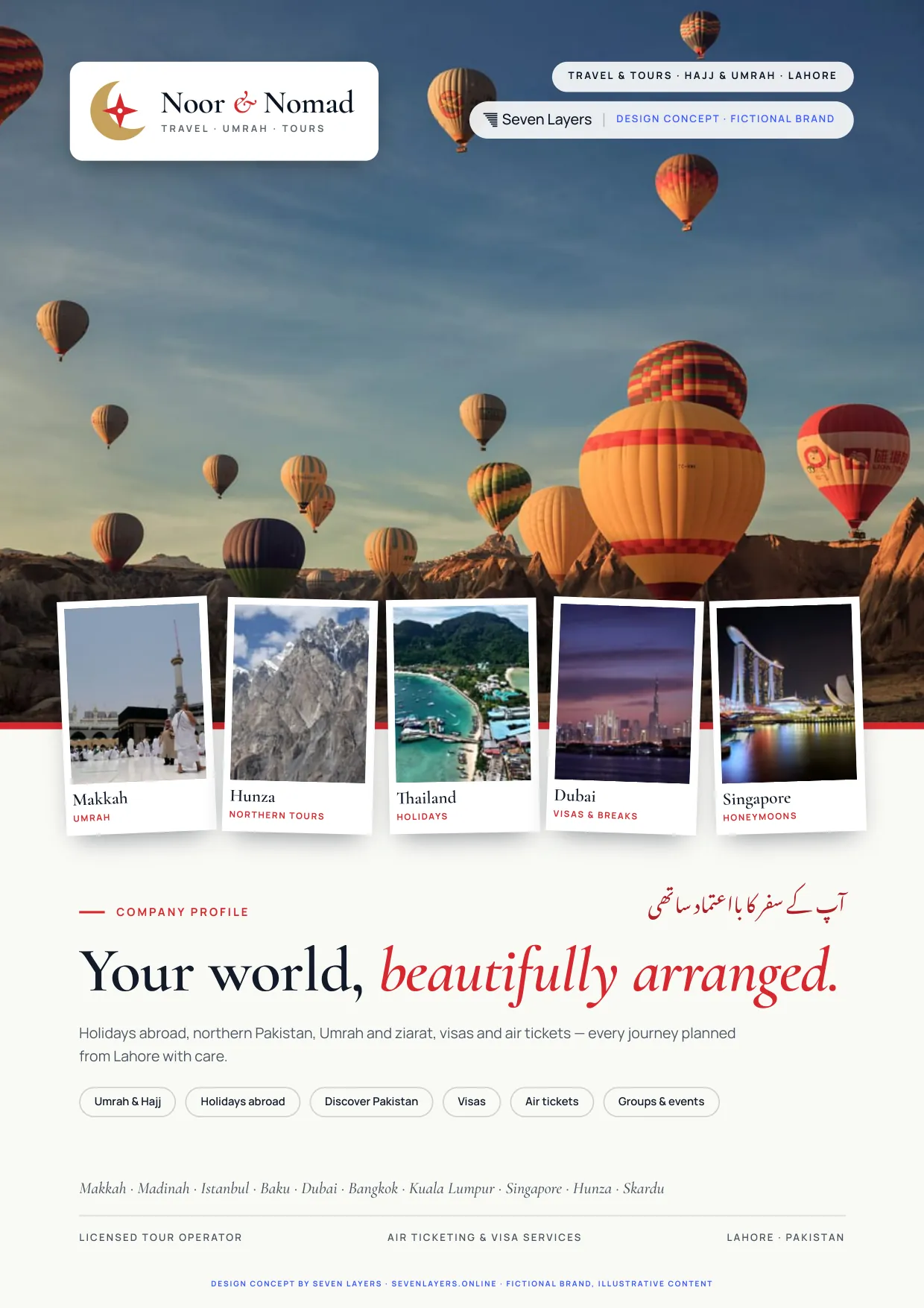
Noor & Nomad Travel — one profile for pilgrims and holidaymakers alike.
A design concept, not client work: a 17-page A4 company profile for a fictional travel, Umrah and tour operator. Faith travel and leisure travel share one document without either feeling like an afterthought; credentials and the booking process come before any package, and prices sit on an insert that can be reissued each season.
- Umrah package tiers, visas, holidays abroad and northern tours
- Arabic and Urdu set alongside the English
- Tables built for scanning, and an anti-fraud notice
- Generated from content files, so prices never mean a redraw
34 businesses we’ve worked with.
Ongoing SEO, social, paid ads and email work — across property, retail, travel, healthcare, engineering and hospitality.
More case studies are coming — when the clients say yes.
We won't publish a client's numbers or screenshots without their written agreement, so this page grows at the speed of permission rather than the speed of marketing. If you would like your project written up, we'll ask you first.
Ready to build something?
Book a free 30-minute call. We'll review your goals, ask the right questions, and get you a written quote within 24 hours of the call.
- 01Websites & stores — brochure sites, CMS builds, Shopify
- 02Custom software — dashboards, inventories, internal tools
- 03Infrastructure & operations — design, deployment, monitoring
- 04Marketing — SEO, social, paid ads, email